Make the model yours.
We tune models on your data so they speak your domain, match your format, and cost less per call.
The 20% of your AI workload eating 80% of your bill.
Most AI spend follows the Pareto rule: a small set of high-volume, repetitive tasks drives the majority of your inference cost, and that is exactly where tuning pays for itself fastest.
The hidden cost is the prompt
Run everything through one big general model and you pay to re-teach it on every call, long prompts packed with examples, instructions, and formatting rules, billed token by token, forever.
Tuning collapses it
Train a smaller model on those specific tasks and it internalizes the format and tone. The prompt shrinks, the per-call cost drops with it, and a 7B–13B model can match a frontier model on the narrow job it was tuned for.
It compounds at volume
A few cents saved per call is nothing at a hundred calls and everything at ten million. The savings scale with the exact tasks you run most.
Base model
Tuned small model
The full model customization stack
From baseline eval to a tuned model running in your stack. All in-house, all measured.
Baseline eval through deployment and optimization. End to end.
Supervised Fine-Tuning
Train on your labeled examples so the model internalizes your format, tone, and domain, not re-instructed on every call.
LoRA and Parameter-Efficient Tuning
Adapter-based tuning: strong results from a few hundred examples, at a fraction of full fine-tuning's compute and cost.
Evaluation Frameworks
Every project opens and closes with a measured eval, so you see what tuning bought, accuracy, consistency, cost, in numbers.
Inference Cost Optimization
Shorter prompts, smaller models, right-sized infrastructure, cutting the per-call cost that scales with your usage.
Model Distillation
Compress a large model into a smaller, faster one, the quality your product needs, without the latency or the bill.
Deployment and Monitoring
We deploy into your inference stack with monitoring, so regressions surface before your users do.
Eval through deployment. End to end.
Supervised Fine-Tuning
Train on your labeled examples so the model internalizes your format, tone, and domain, not re-instructed on every call.
LoRA and Parameter-Efficient Tuning
Adapter-based tuning: strong results from a few hundred examples, at a fraction of full fine-tuning's compute and cost.
Evaluation Frameworks
Every project opens and closes with a measured eval, so you see what tuning bought, accuracy, consistency, cost, in numbers.
Inference Cost Optimization
Shorter prompts, smaller models, right-sized infrastructure, cutting the per-call cost that scales with your usage.
Model Distillation
Compress a large model into a smaller, faster one, the quality your product needs, without the latency or the bill.
Deployment and Monitoring
We deploy into your inference stack with monitoring, so regressions surface before your users do.
Where a tuned model earns its place
The clearest wins come when a tuned or optimized model does the same job for less, or a job the base model couldn't do reliably at all.
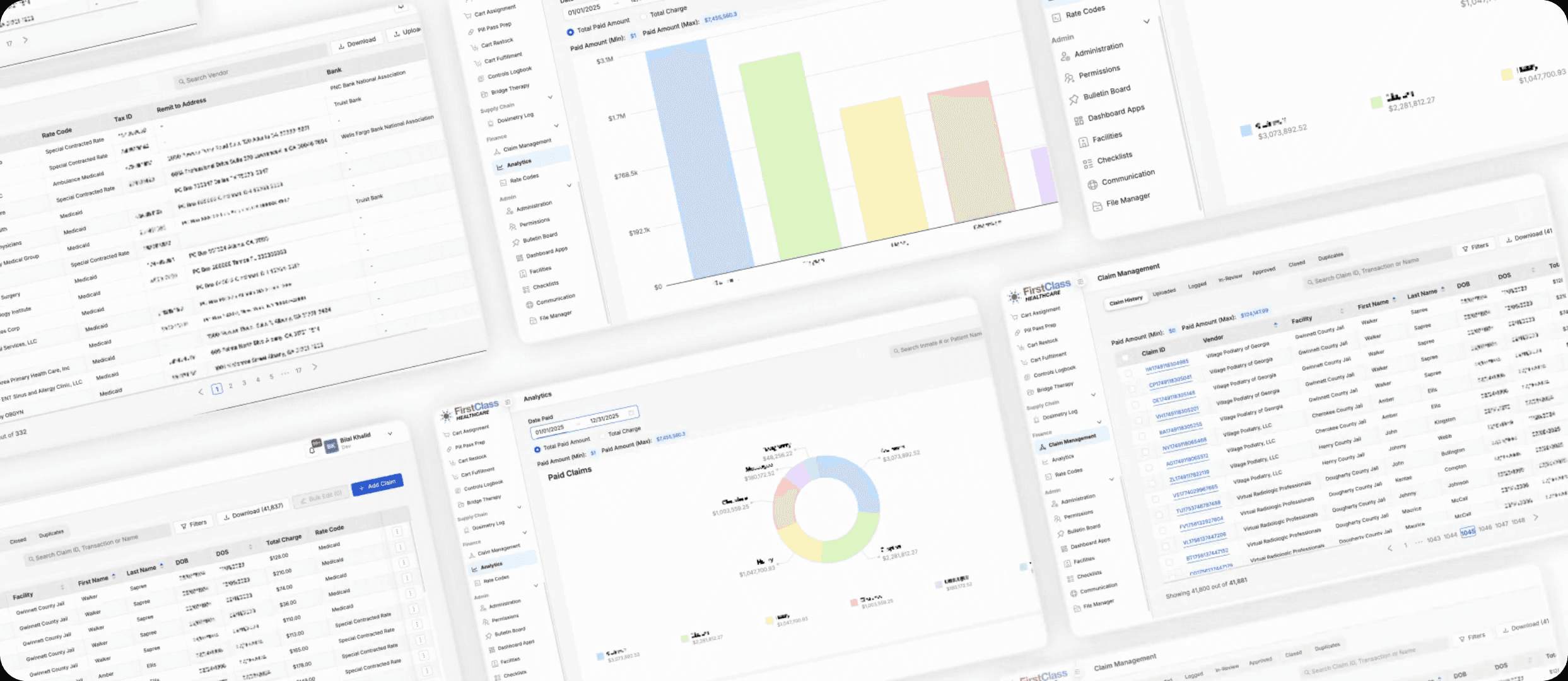
FirstClass Healthcare
AI-Powered Medical Claims Processing
Medical claims in correctional facilities, streamlined by a parser that extracts and structures data from complex documents, cutting manual entry and lifting accuracy at scale.
See the full stories behind these numbers.
Detailed case studies with the problem, the build, and the measured results.
Three ways to engage.
Whether you need to know if tuning is worth it, run a tuning project, or keep a model sharp over time, there is a model that fits.
Find out if tuning is worth it
A fixed-scope assessment: we benchmark your base model, review your data, and tell you honestly whether tuning beats prompting, with a projected before-and-after. No commitment to a full build.
Start a conversation →A tuned model, measured end to end
The full cycle: baseline eval, dataset prep, training runs, and deployment into your stack, with a measured before-and-after so you know exactly what tuning bought you.
Start a conversation →Keep the model sharp over time
Models drift as your data and usage change. Ongoing retraining, eval monitoring, and optimization as a retainer, so performance holds instead of quietly degrading.
Start a conversation →Not sure which model fits?
Tell us what you're building, and we'll recommend the right engagement in one call.
Common Questions
1How is RAG different from fine-tuning? Which one do we need?
RAG gives the model access to up-to-date information at query time. Fine-tuning changes how the model behaves. If the problem is that the model does not know your documents, RAG is usually the answer. If the problem is that the model does not follow your format, tone, or domain conventions, fine-tuning is more appropriate. Many production systems use both.
2Do we need a lot of data to fine-tune a model?
Not always. Techniques like LoRA can work with a few hundred high-quality examples for many tasks. Quality matters far more than quantity. We assess your data during discovery and tell you honestly whether fine-tuning is feasible before you commit to anything.
3Can you work with our existing OpenAI or AWS setup?
Yes. We are infrastructure-agnostic and integrate with whatever you already have. We are not trying to replace your stack, we are building on top of it.
4Will a tuned model actually save us money?
Often, yes, but only when it makes sense, which is exactly what the baseline eval is for. Tuning can replace long, expensive prompts with a model that already knows your patterns, and distillation can move a job to a smaller, cheaper model. We project the cost impact before you commit, so you are deciding on numbers, not hope.
Have any other questions?
Contact UsReady to build something that lasts?
No proposals. No pitch decks. Just an honest conversation about what you are building.